
Cross Country 1951: From New England to
California, Pt II
Philip Spooner
A week or so before we started,
Bob had called to tell us that there were no places in Ridgecrest available to
rent. So much construction was going on, the housing was a real problem. If we
could send him $150.00, he could buy us a house in a location not far from
Ridgecrest on some mining property.
This unseen domicile was located
in the town of Randsburg, twenty-five miles to the South. We could never own
the land but the house would be ours. This done, and since we were near the end
of our transcontinental journey, we all began speculation on what we had
acquired for the hundred and fifty dollars.
Eager conjecture occupied much of
our time in those last few hours as the road map sowed us getting close and
closer. After all, a picturesque miner’s cabin could be just about anything.
At the Randsburg cutoff, just west
of Johannesburg, and on the spur of the moment, we decided we would have a
little guessing contest. We took the turnoff and followed the briefly curving
road into town. On the main street we saw weathered buildings, a battered old
adobe Post Office, a false fronted drug store, there or four other stone aged
buildings, several bars and even a restaurant. Our wildest guesses as to the
nature of the ‘town’ had not even been close. It looked more like an abandoned
western movie set than a real town.
After circling around the other
street of town, we pointed the Dodge down a long steep grade that went
north-west into a valley before us and rose to crest the far hills. The last of
the setting sun grandly extinguished itself beyond the craggy outlines of the
high Sierras. We were now less that twenty miles from brother Bob’s house.
A short time later, rounding the
shoulder of a hill, we came within sight of the glittering lights of the city
of Ridgecrest and the adjacent Navy base. Their welcome brilliance offered to
our minds a sprawling metropolis, lost and alone in the gargantuan wastes of
the Mojave Desert.
Then it really was rather
disconcerting to drive into the city and find it to be a wildly scattered
village consisting mostly of trailer courts, hotels and a motley collection of
odd and partly finished houses.
Driving Into what seemed the
center of town, inquires were made and we finally located my brother’s place.
Upon arriving, we blasted the horn and familiar faces emerged from a house
trailer that was next to party constructed rooms.
Wide grins on our sunburned faces,
female greetings and happy chatter, cousins discovering cousins and overall
relief filled the evening with more cross talk than would be normal. Coffee,
food and more talk lasted Into the small hours, when at last the final
whispered good-nights and tired sighs ended our momentous pilgrimage which was
now into its tenth day since it began.
The opportunity has slipped by on
the ‘Golden Fleece’ deal which Bob had called me about some nine moths earlier.
It had needed the mind and muscle of more than one person. Someone else got the
contract and now enjoyed his business venture with the prospect of continued
and overlapping contracts from the military base.
With six persons to care for, a
few certain necessities to buy, the move into our ‘home’ in Randsburg yet to be
accomplished, our last twenty dollar bill took a real pasting. There wasn’t
much left.
The next morning Bob and I talked
over the possibilities. We went on a brief tour of town. It didn’t seem like a
town really. There were three separate and distinct small business areas. Each
had a grocery store, car repair shops, service stations and incidental
community services. In addition, there was a bewildering assortment of bars and
restaurants. The night before, with my tired worn eyesight, Ridgecrest seemed
to be teeming with people, movement and gaudy lights with blaring music coming
from the beer bars. In the light of day and in the one hundred plus temperature
of July, it became a small desert town that was spread out in the desert. On
all sides we were surrounded by dry salty brackish green trees and a panorama
of majestic mountains to the West (the Sierra Nevada) and an endless view of
receiving dry hills and mountains in all directions.
We returned to Bob’s property.
Next to the trailer was a small bedroom, kitchen and bathroom all on a 12 by 35
foot concrete slab. Nothing pretentious but bought and paid for, and every bit
his own. His very own! As he later explained, he had swapped a 1941 Hudson
coupe and other considerations for the lot, a stack of used lumber, and some
window frames. He also had acquired a battered Ford station wagon in the deal.
The old Yankee Trader instinct had not left him.
It was decided I should break out
my wood-working tools and my union card and make the rounds of the contractor
shacks. They were clustered in a random fashion near the main gate to the base
at the North end of China Lake Blvd. Bob assured me that after working a couple
days I could apply for an advance on my first weeks’ check.
The very first contractor we saw
offered me an immediate job. I mentally thanked the Lord. Now assured of work
the next day, Bob helped us reload the Dodge with our clothes and groceries and some bedding. Leading the
way in his station wagon, we set out of town and drove to Randsburg, which
turned out to be our new ‘home’ for the whole of next year.
At the first sight of the town in
light of day, even with rest from a full night’s sleep, Edwina burst into an
uncontrollable surge of tears, which nothing or no amount of reassurance seemed
to stem.
We drove over a small stone bridge
that traversed a dry rocky gully, and turned up a steep short grade, which
suddenly became level as we drove in beside Bob. He had parked triumphantly before the most
dilapidated in a row of shacks. Weather beaten, heat drained and seeming
abandoned they all appeared, but none quite as forsaken and forlorn looking as
our new home.
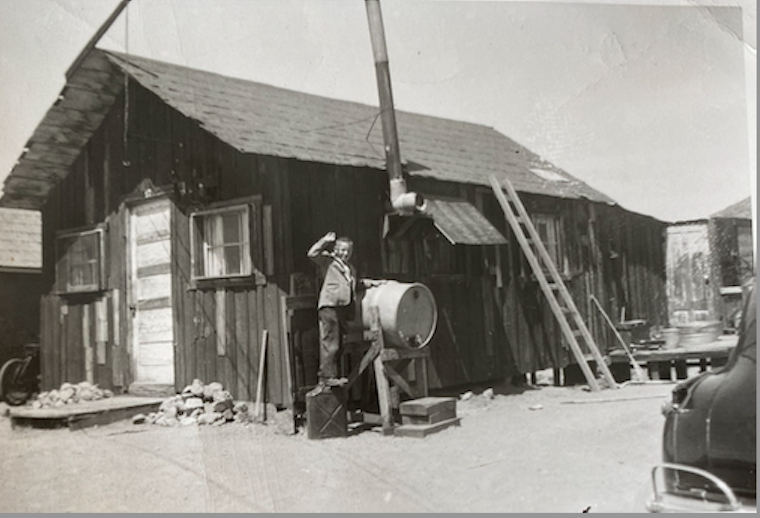
With rising, accusing inflection
in her voice, her chin quivering, niece Judy faced uncle Bob, “This is where
we’re going to live? You can’t be serious!”
Unaffected, Bob, with a grand
flourish, unlocked and threw open the plywood weathered door and invited us in.
The bare brown painted plywood
panels stared at us and the floor sank and rose and we walked across. My poor
dismayed wife, eyes streaming with tears, walked through the flimsy partition
from the front room into what under no circumstances, even laughingly, could be
called a kitchen.
To the right and completely
filling the gap next to the entry, was a greasy, stained and rusty, three
burner gas stove with what could only be described as a miniature oven below.
To the left, a sink, above which were dusty open shelves all the way up to a
low, dirty, gray painted ceiling.
Another door led our timid
exploration party into a ‘lean-to’ section. This contained an iron double
bedstead, which promised little space for passage. Next to this we found
another tacked on lean-to which eventually became know, with its’ concealing
curtain, as “the boys room”.
A final wall of this room was
pierced by a dilapidated door leading to a small porch from which one descended
rapidly to a little one door shack known quaintly as a ‘one-holer’.
The precarious position of this
edifice on the steep edge of the gully behind the house later proved to be an
irresistible temptation for Halloween pranksters. After we moved out a year
later, the neighborhood boys pushed our outhouse over and into the ditch.
The gully itself presented a
dismal picture of old tires, tin cans rusted with age, indiscriminate parts of
ancient autos and flotsam of boards, 3 gallon gas cans, rocks and various
non-discernible items left behind from the turn of the century gold rush
population and more recent inhabitants.
Bob, from behind the concealment
of his hand told me confidentially, “I hosed her out real good. Hey, I almost
forgot, you water’s going to cost a cent a gallon.”
He then spoke to all of us in
general. “There’s a miner living just below the Yellow Aster mine area. He’s
got a bunch of kids and he’s the proud owner of the only flush toilet in town.
Every day they have a water closet ceremony and flush it every morning.”
At this point, my spirits were
dragging low. But at least we were here. No going back. Twelve dollars in the
coffee can. Soon, my natural exuberance burst through and my outlook became
more optimistic. I’d go to work tomorrow, food would be on the shelves, we
would adjust to our surroundings. The roof might be patched with the bottoms of
5 gallon cans but they did work. There wasn’t any rain anyway. The floor
creaked, the rooms were small but somehow we all fit and made it work. And hey,
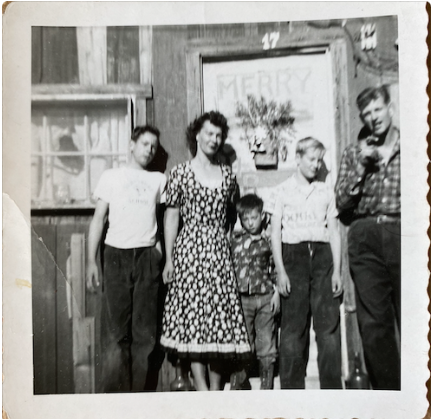
it was bought and paid for. Our very own !
Three months later, after enduring
sand storms that lifted the floor boards and whistled in through the walls, a
very little rain and lots of dust from sand hill half a mile to the West, new
friends and new faces entered our lives. The deluge of tears which had been for
so long a daily occurrence, began to lessen. With more smiles and acceptance of
our circumstances, Edwina’s natural homemaking instinct transformed the ‘shack’
into a feeling of permanence. It was now our home. Pictures adorned the walls,
shabby furniture was brightened with covers and the windows sparkled clean.
She went to church, joined with
the sewing club, she and Judy explored the town and met more people. Edwina
eventually adopted a philosophical viewpoint and found it less necessary to
worry about the heat of the desert sun, the lack of familiar New England family
members and ‘conveniences’. She found time filling with new interests to keep
her busy and occupied.
Judy, vivacious, pretty and
sixteen, soon had a group of girl and boy friends. There were moments when
Edwina and I had concerns over her but as it turned out, she was very sensible
and capable and conducted herself in quite the proper manner.
High above us to the South, lay
the gigantic pile of tailings from the famous Glory Hole of days gone by. The
riches of the Yellow Aster mine were counted to nearly a hundred million in
gold during those early years of our twentieth century.
From stories of the wild western
roughshod gold camp of the past to the summer influx of the tourists coming to
witness the annual Frontier Days celebration in town, there was lure about this
dusty worn out town that began to appeal to us all.
That winter, shortly before
Christmas, snow covered the ground and the boys and Judy all disappeared into
the night following footsteps and making new ones as the snow flakes softy
fell, reminding us of snowy Massachusetts and our former home of the East coast
of the United States.
The story does not end here. This
brief descriptive adventure hopefully will serve to remind us that in spite of
discouragement and setbacks, breakdowns and almost no money, we were happy to
follow our instincts and discover for ourselves a new beginning.
Philip E. Spooner, writer
Nathan B. Spooner, edits
 |
 |