
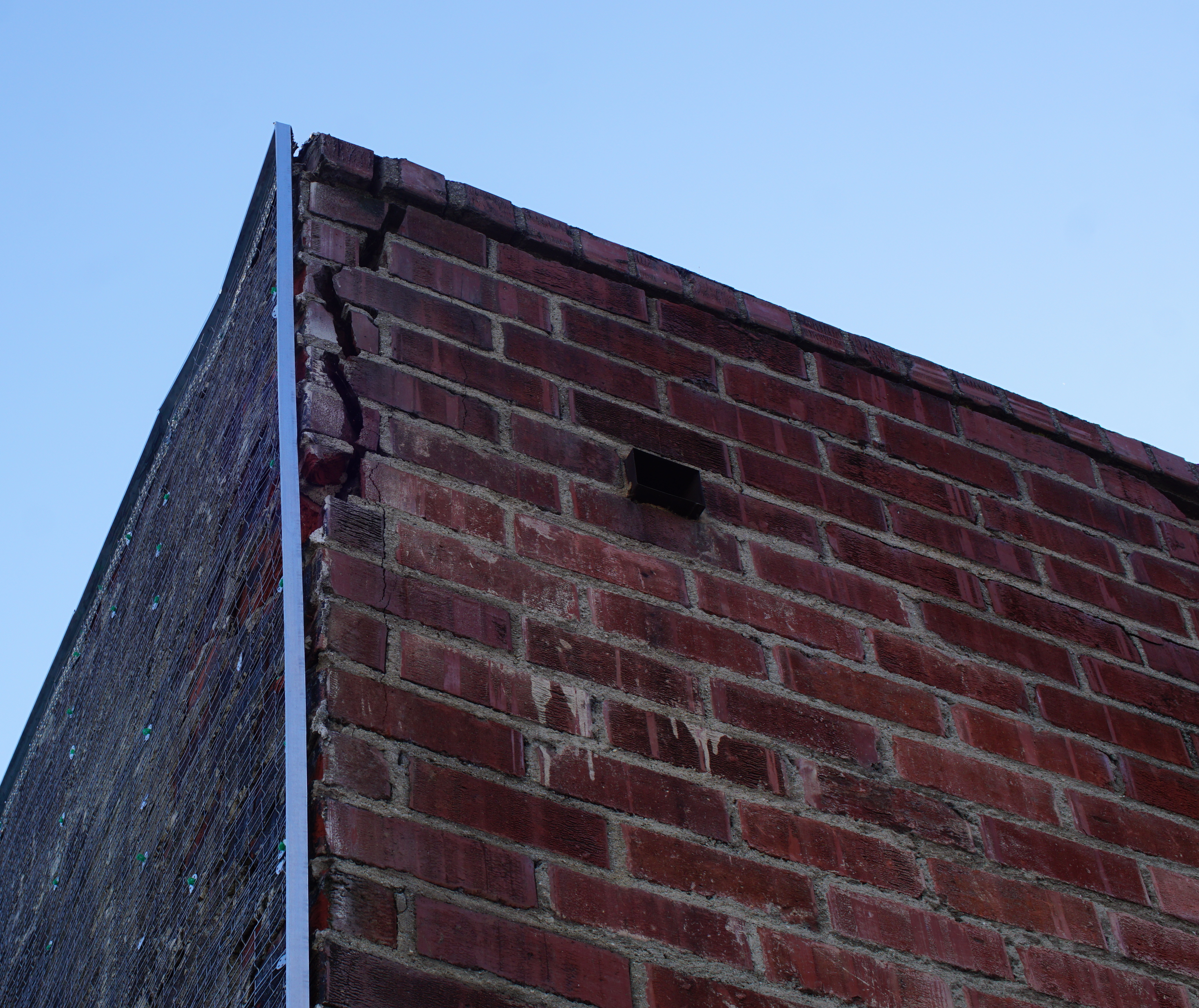
Unreinforced
Masonry
Deputy
Frank and Sam
Unreinforced
masonry? After over 100
years the City Fathers were ‘shocked’ to discover that the old Central
Office
Building is constructed of ‘unreinforced masonry?’ A fancy word for
bricks.
Plain old red bricks plastered over sometimes and painted a light tan,
like the
desert sands. Unsafe now? Lonestar thought of this as he looked around
the long
abandoned ‘pool room,’ the room that once housed the large Typing Pool.
He
could see the sky through the large cracks on the high wall near the
roof and its
long heavy beams of wood. The room long used for storage was empty now.
Just
some smells left, some unsettling.
“Birds
and small critters get in here”
the Dance Master remarked. Because of his experience up North at the
State
Capital the City asked him to look the building over. Hope is that he
could
help get State funding to make the structure safe again. He asked
Lonestar to
come along because of his experience in construction. And better to
have
company when exploring large abandoned buildings. There were stairs
down to
passages and rooms one level below ground. Passages led to one room
after
another. These spaces seemed to be for the maintenance and custodial
staff.
Downstairs
are shelves and file
cabinets, some with files left inside. The largest space had work
benches with
pieces of pipe and electrical cords. A staff room had a kitchen counter
and a
space for a refrigerator. All dust and smells. The passage had closets.
Some
doors were open. A few keys scattered on the floor. One closet door was
blocked
by a large workbench. Dance Master and Lonestar gave each other a look
as they
worked to move the bench. The door was locked, They gave each other
another more
looks as Lonestar tried several of the keys lying on the floor. They
opened the
door.
***
Sam’s
and my current spell of leisure patrolling the
out of the way parts of the County Wilderness Trust sadly came to a
close (just
for now I hope) when Sheriff called us back to town to appear in his
office. No
more lions. And I just got Sam trained not to chase the lions. And so
again at
his office at 900 AM, no waiting. ‘This should keep you busy Frank.
What we
call here a cold case, you might say a ‘bare bones’ case.” Sheriff was
quite
tickled with himself when he said “bare bones.” “So go on over and see
you pal
Ed to start. The other ‘to start’ is this report.” He handed me a
folder.
“Would
you like a donut Frank? I have a few left.” That’s
an Ed sort of greeting. I could see he just about finished his mid
morning
quart of beer. Next to his desk was an examination table with a full
human
skeleton laid out, all bones in order. I think. Next to the table on a
rack hung
an elegant man’s suit. Not a suit you want to wear just now though.
Next to it was
a small table with a necktie, some jewelry, billfold. In a bag there
appeared
to be the remains of a shirt, socks, shoes and etc. “Frank, the
gentleman is a
Mr. Bo Cellar.”
“I
know he’s dead. Ed.” “Now Frank, would I repeat an
old tired Coroner joke like that?” Ed could not tell me much except
that Cellar
died apparently of starvation or disease or at the hands of another or
by
accident. There was not enough tissue to run any tests for diseases. No
sign of
injury. I thanked Ed. As I left he took the near empty beer bottle over
to the
snake’s cage and poured a little in the saucer inside. The report the
Sheriff
gave me had a lot of information.
***
A
lot of information on the past that is. First
about the building. It is not a typical office building in that it has
a large
open room, most of the street floor, that for years housed the Typing
Pool.
There were long rows of desks where women, and an occasional man,
worked at
typewriters. The Pool took in typing requests from all over the city,
both from
businesses and government agencies. Work there is described by
contemporaries
as workers typing as one or more Superintendents, called ‘supers,’
walked back
and forth between the rows of desks, notebooks in hand. Messengers
constantly
came into an adjoining Front Office bringing new or picking up finished
typing
projects.
The Front Office
had the Director’s Suite, and desks for receptionists, bookkeepers, and
cashiers. The Director was our Mr. Cellar. He was until the whole
operation
shut down about 30 years ago. Advances in technology and changing
business
procedures and organization made the need for a central typing agency
unnecessary. So all at once all employees were ‘set free’ and
equipment, desks,
typewriters, and all were auctioned. There was no market for the space
left so
it turned by default into a storage area. As we investigated we learned
from
former employees and customers that no one remembers seeing Cellar
anywhere in
town after the shutdown.
The
‘we who investigated’ were, again, Lonestar,
Sam, and I. We were able to find former employees, both from among the
pool
typists and some who worked in the Front Office. People who worked
there seemed
not to forget much about it. We were of course looking for any
information
about anyone who might want to harm Mr. Cellar.
***
The
women typists all had pretty much the same memories.
They said some before them had been there for their entire work life.
There
were strict codes on dress, ‘business attire’ that covered their arms,
high
necklines, skirt length that went below the knee while sitting. Supers
would
pinch the women’s legs to be sure they were wearing hose. The few men
wore
business suits. When the typists finished a job they remained seated
until an
office ‘runner’ brought them a new job. If it took more than two
minutes to
start a new job the typists were docked in pay. As a way for ‘hazing’
new
typists or disciplining typists who were thought to have a ‘bad
attitude’ or
‘belligerent body language’ Supers would delay runners bringing new
jobs. The
typists were also docked in pay for each piece of paper discarded
because of
typing errors.
The
few men who joined the Pool typically did not
last long there. Most had learned typing while in the military and took
a job
in the Pool after discharge to support school or while deciding what
they
wanted to do back in civilian life. Some because they liked typing. The
Pool
contained some ‘man haters’ and Supers would encourage them in making
the men’s
time miserable as a way to divert anger from themselves. And so most
men left.
Some men we questioned had the Pool in their nightmares, more
nightmares than of
their military service, even combat in the Alta “mission” or in the
Coffee
War.
At
times a typist was called into Mr. Cellar’s
office for ‘counselling.’ (Staff called it the ‘Go see Bo.’) We
discovered in
our questioning that he was finding out who among the pool was most
willing to
inform on the others or on the Supers. And so to advance to be a Super.
When
there was an opening there was much drama by management and much hatred
and
maneuvering among the few who competed for the position. When Cellar
announced a
new Super it happened that the one who made the most trips to his
office got
the promotion. When a Super position was filled there was a period of
‘scores’
being settled. This produces another group of suspects, those purged.
***
“Why would
anyone work in such a place” I wondered aloud. “Some folks, like you
and I,
have more choices” Lonestar answered. To solve this case we have to
find out
all we can about Cellar. It did not take us long to understand that he
did not
really have much of a grasp of what it took to run the operation. He
was at the
mercy of the official, and unofficial, structure in the Pool and the
Office. It
was an open joke among the staff that his Secretary and the Supers
propped him
up. Who would benefit from him being locked in a closet?
Was there
some fraud involved? We have to talk to more people and look at any
files we
can find. The company, actually called The Typing Pool, was owned by a
large
investment firm, one that bought small companies around the country.
The parent
company did not care about anything in the companies they owned except
the
monthly profit and loss statements and when or if the profits turned
into
losses in a company they closed it all down. The parent companies used
an
Executive Placement firm to hire Cellar and likely never met him. We
briefly
talked to his last Secretary and have to interview her in more detail.
The
Secretary was the only surviving secretary
Cellar had and had only been in the office a few years before the
company
closed. We did not spend time with her when we first started because of
her
short time with Cellar. Now we need to be thorough. Her name is Ester
Lump and
she recently retired from Valley Land. She never met Lonestar when he
was there
but she knew about him. That is good. She is large but pleasant and did
well at
Valley Land. She remembered Teddy Floe fondly. Ester has little formal
education but a lot of common sense, the type of person that makes
organizations work.
We
met her for lunch at a booth at Rusti’s. She said
‘Cellar was the type of person that needed help, you want to help. At
first
anyway. Then you helped and kept things from falling through the cracks
only for
the good of your coworkers.’ “What changed” we asked. She turned angry.
‘He
started making hints to me, you know what I mean. I didn’t mind so
much, part
of the territory for secretaries. But then he would complain about the
women in
the typing area, including the Supers. They were all dogs, pigs, a zoo
and the
like.’ “Did the women know he said those things?” Lonestar asked. “Oh
yes, they
all knew.”
Ester
had no sense that there was anything
fraudulent or corrupt going on in the company. The bookkeepers were all
‘church
lady’ types (also subjected to Cellar’s comments). “Did Cellar drink on
the
job, take drugs?” We asked. ‘If he did it was not obvious’ she replied.
“Did he
spend all his time in his office?” Lonestar asked. ‘He spent most of
his time
there. He liked sitting at his desk posing under his diplomas and other
framed parchments
on the wall behind him.’ She thought for
a moment and added ‘once in a while he would go down stairs and talk
with the
maintenance staff. We think they told jokes, We could hear loud
laughter.’
Just
as we were starting to thank Ester she said
‘There was something that happened when I first started. I think it is
important, but maybe it isn’t. Some of the typists formed a committee
and said
they wanted to meet with Mr. Cellar. He agreed, looking at me, rolling
his
eyes. Four of the typists came to the office. One had a Report,
nicely
typed of course. They said that had been talking to typists and
secretaries
they knew in other companies in the city. They learned that the other
companies
were depending less and less on typing.’
‘More
they were using the new machines that had been
invented to duplicate documents. At least the larger companies were.
The
smaller companies could not afford the copying machines and wished
there was a place
where they could take documents to have them copied. The committee of
typists
made a count of the smaller companies. The said that if our company
added ten
copy machines, and advertised the service, that we could have this new
business. And we would not have to worry about having to hire a skilled
typist
every time a vacancy occurred.’
‘The
typists had prepared a detailed Report
of their finding and handed it to Mr. Cellar. He just stood there with
an
amused look on his face. The woman who tried to hand him the Report
stood there holding it out in front of her. After a long pause he
slowly took it.
And then asked “is there anything else?” And that was all he said. The
women
looked at each other, then turned around and walked out the door. This
was one
of the worst experiences of my life. I started looking for another job.
Mr.
Cellar said something to the effect of “I just let those dogs waste my
time.”
He threw the report they gave him into the trash.’
‘I
picked the Report up out of the trash in
front of him. I said it would be in the file cabinet downstairs. He
looked at
me with a smirk saying “Suit yourself.”’ We thanked Ester. Lonestar
walked her
out to her car. We could find no maintenance staff still alive. What
next? Ester
was not there when the company closed. She said she soon after took the
job
with Valley Land. That was a few weeks before the end. What happened
that last
day?
We
have to talk to staff who was there during the time.
After thirty years the only former members of the typing pool still
alive had
been then when they were very young and not for many years. They could
tell us
of the work rules and the like but not too much about the long term
culture
there. We had talked to them before about the company generally and now
wanted
to know about the last days. There was nothing to add except for the
chaos. The
private Company Police came in force and gave everyone five minutes to
gather
their personal property and leave the building.
There
was no warning. The Company Police began by
setting off noise bombs just outside the building. Windows rattled and
the room
shook. Police screamed in bull horns and entered the main room shoving
anyone
who hesitated. They carried clubs and cattle prods and riot shields.
There was
terror and crying and some injury as the staff cleared the building.
Some of
the older women had to be carried by the younger with help by some of
the men.
No one we talked to could tell us anything about Mr. Cellar. Not then.
A few
days later one of the women contacted Lonestar and said she wanted to
talk to
us alone.
He
name is Nancy. She had formed a friendship with
one of the older employees, long since dead. They had remained friends
after
the company closed. After some years she told Nancy about her
experiences
during the last day. She had not been in the main room when the Company
Police
arrived. She was in the hallway that led to the Front Office and that
had the
stairway to the lower level. As Nancy remembered she said ‘when the
commotion
started Cellar came running out of his office. His face was flushed
red. He was
screaming about “the report. And wait, wait. I demand to show you the
report.”
Two Company Police came after him yelling “where do you think you are
going?”’
‘Cellar
ran downstairs and the two Company Police
went down after him.’ Nancy said she told her she ‘stayed where she was
at the dark
end of the hall, and crouched down in the corner behind a chair and
waited for the
noise to stop and the smoke to clear. She could hear some commotion and
yelling
from downstairs but could not understand what was being said, except
she
thought she heard the words “report” and “I demand” again. More noises
but from
all directions. As she waited the noises from everywhere started to
subside.
After more waiting the two Company Police came back up from downstairs.
There
were looking back and forth and seemed agitated. They did not notice
me.’
‘All
I could think of is waiting until I could get
out of the building. The two Company men were talking excitedly. The
only thing
I heard was “not a word” and I think “split up.” When the hall was
empty I got
up and quickly and quietly walked through the smoke down into the Front
Office,
which was empty, and out to the street. Company Police were standing
around as
I walked through. No one noticed me thank heavens’ We ask Nancy if her
friend
ever said anything more about Cellar. Did she wonder what happened to
him after
he went down stairs?
Nancy
said ‘no. I think she was too shocked at the
time to think about anything besides getting out unharmed. If she
thought about
him in the years after she did not say anything to me. She might have
thought
he got out just like she did.’
***
Sheriff
listened to us as we told all we learned. He
agreed that we could only conclude what happened, not definitively
prove it. He
accepted our final report and conceded that any reasonable reader would
agree
that we did all we could to solve the case.
***
Several
days after we met with Sheriff. Sam and I,
and Lonestar, and Dance Master met in a booth at Rusti’s. Rusti joined
us. I
had beer, Sam has his saucer of same, Lonestar coffee, and Dance Master
Valley
Red. We chatted about the case including philosophical asides about the
ambiguities in human life. How ‘loose ends’ don’t tie up like they do
in the detective
stories. Dance Master found the Report the Secretaries wrote in
the file
cabinet downstairs in the Central Office Building. He showed it to us.
It is
excellent in detail and numerical data and includes a long list of
companies in
town that might be customers.
Dance
Master did some research and learned that
several years after the Typist Pool closed, several of the former
employees
formed a company in a nearby office building. They offered copying
machines,
and a few typist stations, and had a going concern for about five years
until
they were bought out by a larger company.
And
Rusti asked ‘what did we think of it all?’
END